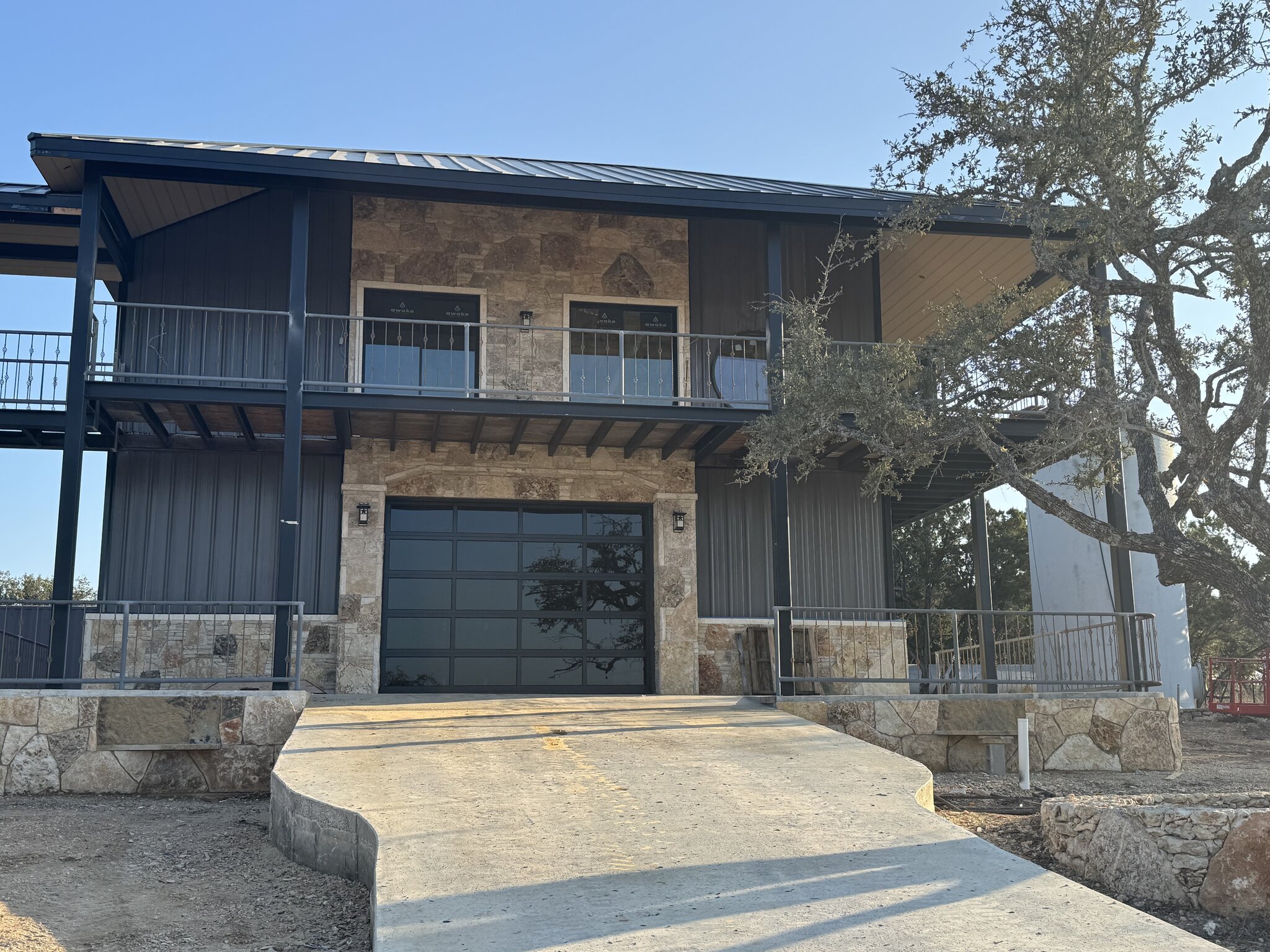
Buying land to build a house in the Texas Hill Country costs more than the sticker price on the lot. Rural land in the Austin-Waco-Hill Country region hit a record median of $8,040 per acre in the second quarter of 2026, according to the Texas Real Estate Research Center at Texas A&M. The house is a second number. NAHB puts the median custom home started in 2025 at $171 per square foot nationally, and that price does not include the lot.
Neither figure covers the work between buying the land and pouring the slab: cutting rock, a septic system the soil can carry, a well, a driveway, and power. That middle layer is where a good deal turns into a bad one, and almost all of it can be checked before you buy land. Here is the due diligence Iron C Construction runs on Hill Country land before a client commits.
What does buying land and building really cost in the Hill Country?
The Texas Real Estate Research Center figure is a median for rural tracts across a large region, and the typical tract in that data runs about 199 acres. A five-acre homesite near Wimberley is a different market, so treat the regional number as a trend line, not a quote. Prices there rose 8.63 percent year over year, so the direction is clear.
On the build side, NAHB’s analysis of Census data put the median custom home in the West South Central division, which includes Texas, at $138 per square foot for homes started in 2024. Nationally, its 2024 builder survey found the finished lot averaged 13.7 percent of the sale price on a typical new home. Those surveys assume a buildable lot. Raw Hill Country acreage often is not one yet, and the cost of making it one sits outside both numbers. That gap is the part of buying land in Texas that listing prices never show. We break those site lines out in our line-by-line Hill Country custom home budget.
Start with what is under the dirt
The single biggest unknown on Hill Country land is how close the limestone sits to the surface. Near-surface rock in the Hill Country west of Austin belongs to the Glen Rose Formation and Edwards Group, according to the UT Bureau of Economic Geology. Those layers are 100 to 112 million years old. Soil over that limestone is often thin, and two lots on the same road can look completely different a foot down. Rock is a solid base for a foundation, but it has to be hammered or cut instead of dug, from the house pad to the utility trenches and septic field.
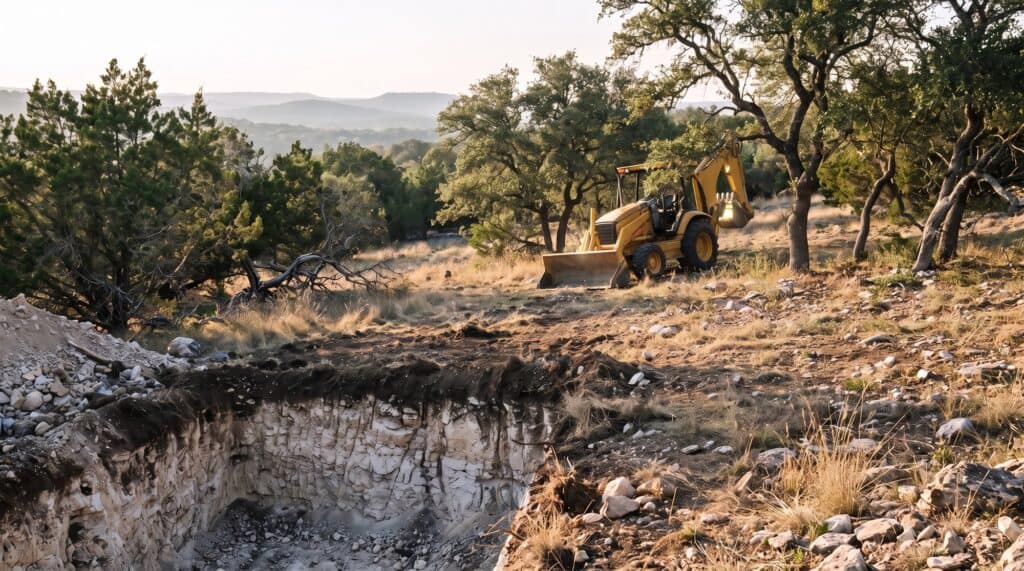
A few test holes before closing tell you more than any listing photo. Ask the seller for access during your option or feasibility period. A backhoe pit at the likely house site and another where the septic field would go will show rock depth, soil type, and whether you are looking at soft caliche or a hard shelf. That answer shapes the foundation design, the septic system type, and a real share of the budget.
Read the slope before you fall for the view
The view that sells a Hill Country lot usually comes with grade. A sloped site is buildable, but it changes the foundation, the cut and fill, the driveway, and how stormwater moves around the house.
Walk the land with the house in mind. Where would the slab sit, which way does water run after a hard rain, and can a concrete truck and a drill rig reach the site? Iron C Construction places homes with GPS and robotic construction staking so the structure lands where the plan says it should. That is construction layout, not licensed land surveying. Your boundary survey still comes from a licensed surveyor, and you want it before you close.
Check the floodplain map before you check the price
Creeks are part of the appeal out here, and the reason to pull the flood map first. FEMA defines a Special Flood Hazard Area as land expected to flood in an event with a 1 percent chance of happening in any given year. You can look up any parcel on the FEMA Flood Map Service Center or ask the local floodplain administrator, according to FloodSmart, the federal flood insurance program’s site.
In communities that participate in the National Flood Insurance Program, flood insurance is mandatory for federally backed mortgages on high-risk properties, per FloodSmart. Building in the floodplain also changes permitting. In unincorporated Hays County, the 2026 fee schedule lists a development permit at $100 outside the floodplain and $300 for a habitable structure inside it. A lot with its house site well above the mapped zone is a very different purchase from one where the only flat ground sits next to the creek.
Prove the lot can carry a septic system
Without city sewer, your lot has to treat its own wastewater, and not every lot can do that cheaply. Under TCEQ rules, the site must be evaluated by a licensed site evaluator or professional engineer before a septic system can be installed. The local permitting authority then has 30 days to approve or deny the application, according to the TCEQ OSSF permitting page.
State rules require lots of at least one acre in newer subdivisions that use individual septic systems and are not on a public water supply, under 30 TAC Section 285.4. Fractured rock is rated unsuitable for a standard tank and drainfield, which pushes many Hill Country lots to an aerobic or other secondary treatment system that costs more to install and maintain. TCEQ also describes a “10 acre rule” that can exempt a single home on 10 or more acres from the permit when every other requirement is met. Even then, the site still needs an evaluation, and every part of the system must sit 100 feet from the property line.
So before you buy, find out where the septic field could actually go and what kind of system the soil supports. Our post on how the well and septic timeline works on a new build covers the permitting sequence after you own the land.
Find out which groundwater district governs the well
Most Hill Country homesites rely on a private well, and the rules depend on which groundwater conservation district covers the tract. A license is required to drill a water well or install a pump in Texas, and the Texas Department of Licensing and Regulation oversees that work. The Texas Water Development Board points owners to the Texas Alliance of Groundwater Districts database to find the district for a given location.
In northern Hays County, for example, the Hays Trinity Groundwater Conservation District requires new wells to register and asks for the distance from the well to the property line, septic tank, and drainfield. A new owner must also register an ownership change within 60 days of a real estate transaction. Spacing rules can box in a small lot once the house, septic field, and well all need room. Ask the district about current rules and drought restrictions before you close, since depth to good water varies widely across Central Texas.
Access, power and the paper that limits what you can build
A lot is only as good as your legal way in and the cost to bring power to it. Confirm with your title company or attorney that the tract has recorded access, not just a gravel track across a neighbor’s place. If the driveway will connect to a state highway, TxDOT requires a Form 1058 permit through the local district office. Power is the other surprise. On Pedernales Electric Cooperative lines, for example, the applicant pays the full cost of extending service up front as a contribution in aid of construction. The co-op also wants the house site staked and septic fields marked before it designs the line.
Then read the paper that comes with the land:
- Deed restrictions and HOA rules. Texas Property Code Section 5.012 requires a seller of residential property in a property owners’ association to give the buyer notice before the contract binds. Read the actual restrictions for minimum home size, setbacks, building materials, and rules on barns or guest houses.
- Agricultural valuation. If the land carries an ag appraisal and you change it to a homesite, the Texas Comptroller says rollback tax is due for each of the previous three years, plus interest on 1-d land.
Walk the land with a builder before you buy the lot
The cheapest time to find a problem is before closing, and most people who buy land and build a house in Texas only get one chance at it. Iron C Construction has walked Hill Country land with buyers since Robert Castro founded the company in Wimberley in 2020. Construction Coordinator Arthur Leyva brings more than 20 years in the trade to that walk. We look at the lot the way a builder has to build on it, not the way a listing describes it. If you plan to build on your lot in the Hill Country, that walk is where the budget starts.
A pre-purchase site walk with us covers the questions that move the number:
- Where the house, septic field, and well can each fit, with room for spacing rules.
- How the slope and likely rock depth affect the foundation and excavation.
- Whether the building site sits clear of the mapped floodplain.
- How long the driveway and power run will be, and what that means for cost.
None of this replaces your surveyor, title company, site evaluator, or attorney. It adds a builder’s read on the land while you can still negotiate or walk away.
Have a tract under contract or in your sights? Talk to us before the option period runs out. We will walk it with you and give you a straight answer on what the rock, slope, water, and paperwork mean for your budget. See how we build on your lot, then reach out to Iron C Construction to set up a site walk anywhere across Greater Austin and the Central Texas Hill Country.