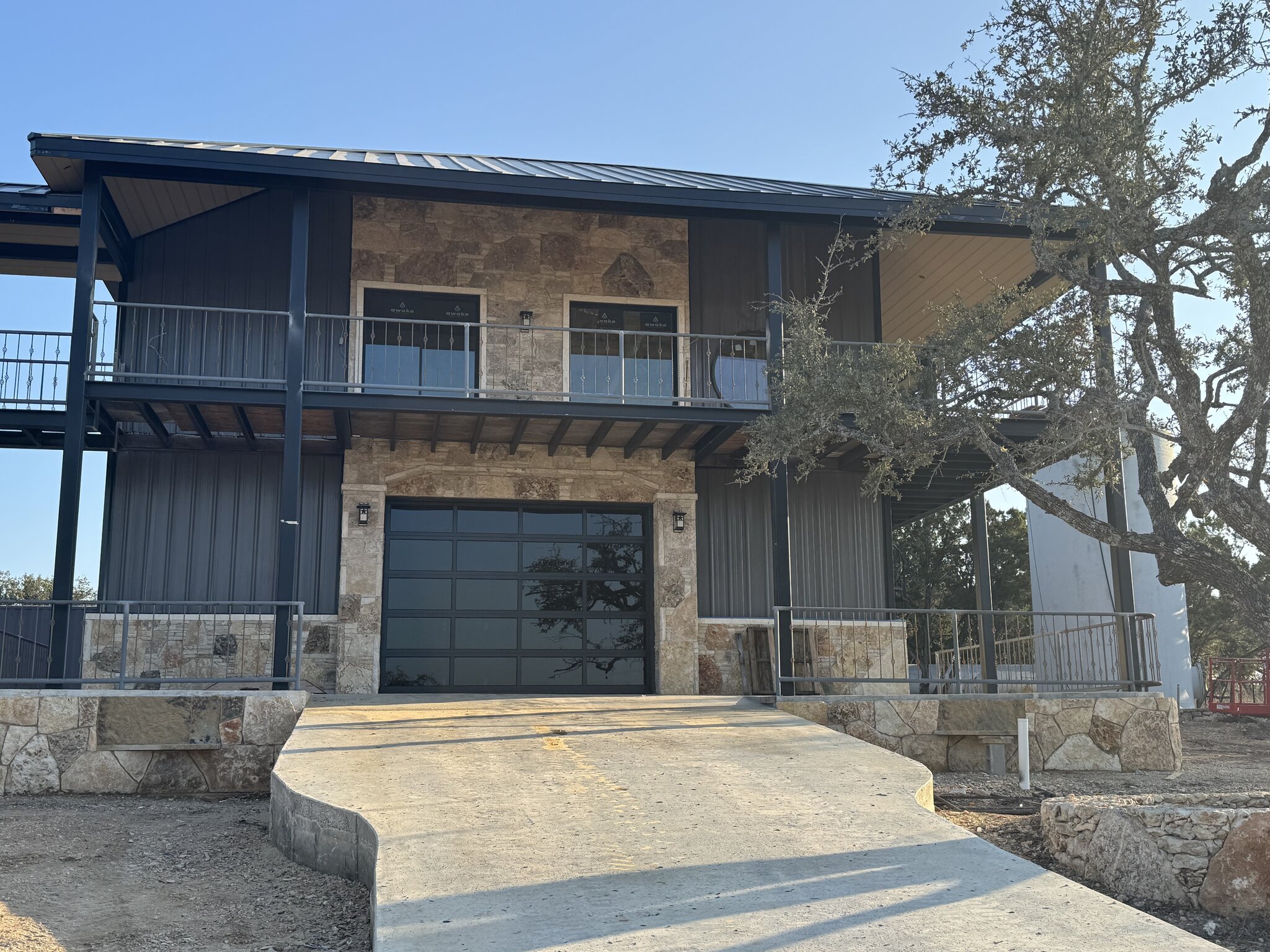
The cost to build a 2,000 square foot custom home in Texas works out to roughly $276,000 to $342,000 for the house itself if you use published benchmarks. NAHB’s analysis of Census data put the median custom home in the West South Central division, which includes Texas, at $138 per square foot for homes started in 2024. The national median for custom homes started in 2025 was $171, according to NAHB’s Eye on Housing. Both figures leave out the land.
In the Texas Hill Country, the house is only part of the custom home cost. Rock excavation, a septic system that fits the soil, a well, a long driveway, and a power extension can each become their own line item. Below is how Iron C Construction thinks about a Hill Country budget in 2026, line by line, using sourced benchmarks and national cost-guide ranges. None of these numbers is a quote, and none is our price.
What does a custom home cost to build in Texas?
Two different per-square-foot numbers float around online, and they measure different things. The first is a median contract price: NAHB’s Census-based figure of $171 per square foot nationally for custom homes started in 2025. Custom contract prices do not include an improved lot, because those homes are built on land the owner already holds. The second is an average construction cost: NAHB’s 2024 Cost of Constructing a Home survey of 41 builders found the typical new home cost $428,215 to build, about $162 per square foot. That is the highest in the history of the series.
Use them as a starting line, not a finish line. NAHB itself warns that its survey “is not a perfect tool for estimating costs” for a specific house in a specific place. The survey’s average home was 2,647 square feet on a lot of 20,907 square feet, just under half an acre. That is a suburban lot with streets, water, and power already at the curb. Hill Country acreage rarely comes that way. Land is its own purchase, too: rural tracts in the Austin-Waco-Hill Country region reached a median of $8,040 per acre in the second quarter of 2026, per the Texas Real Estate Research Center.
Where the money goes inside a custom home
The 2024 NAHB survey breaks construction cost into eight stages, and the split is a useful sanity check on any custom home budget. On the national average home, the shares looked like this:
- Interior finishes: 24.1 percent, the largest single stage, covering cabinets, counters, flooring, paint, and trim.
- Major systems rough-ins: 19.2 percent for plumbing, electrical, and HVAC.
- Framing: 16.6 percent, including the roof structure.
- Exterior finishes: 13.4 percent for siding, roofing, windows, and doors.
- Foundations: 10.5 percent, including excavation, concrete, and backfill.
- Site work, final steps, and other: 7.6, 6.5, and 2.1 percent.
Finish choices move the biggest stage, so that is where design decisions pay off. Locking finish allowances early keeps the interior line from creeping while the house is going up.
What national costs leave out on Hill Country land
NAHB’s “site work” stage is mostly fees and paperwork. In the 2024 survey it covered building permit fees, impact fees, water and sewer fees, and architecture and engineering, about $32,719 on average. Excavation sat inside foundations, and the driveway averaged $9,635. Those are suburban numbers for a lot that is already served.
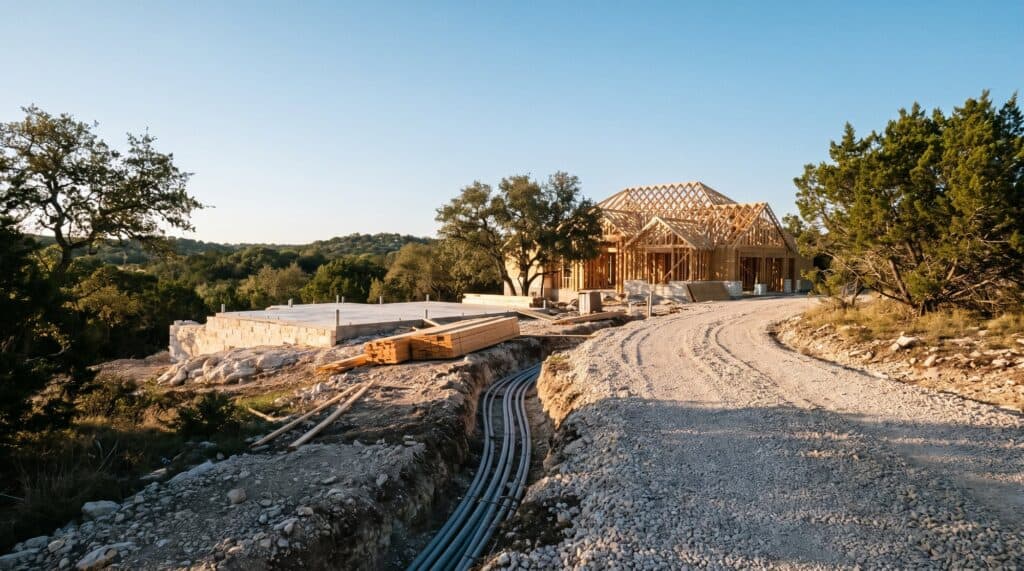
On raw acreage, you are building the infrastructure the subdivision would have built. That means your own wastewater treatment, your own water source, a road to the house site, and a power line to reach it, often across limestone. These lines vary more from lot to lot than anything inside the walls, which is why we look at the land before we talk about finishes. If you have not bought yet, start with the due diligence to run before you buy Hill Country land.
Rock excavation and the building pad
Limestone close to the surface is common in the Hill Country, and rock has to be broken rather than scooped. National cost guide HomeAdvisor lists rock blasting at $40 to $100 per cubic yard and says rocky terrain can add $200 to $1,200 or more to an ordinary excavation job. In practice, Hill Country rock is often hammered or ripped instead of blasted, so treat that range as a signal, not a bid.
The rock line shows up in three places: the house pad and footings, the utility trenches, and the septic field. Solid rock is a strong base for a foundation, which is the good news. We walk through how that tradeoff plays out in our post on what building on solid limestone adds to a custom home budget.
Septic and well, the two lines rural buyers underestimate
Septic system
Soil decides the system, and the system decides the cost. TCEQ rates fractured rock as unsuitable for a standard septic tank and drainfield, which pushes many Hill Country lots toward an aerobic or other secondary treatment system. HomeAdvisor’s national ranges put a conventional system at $3,000 to $8,000 and an aerobic system at $10,000 to $20,000. In unincorporated Hays County, the 2026 fee schedule lists the single-family septic permit at $610 plus a $10 state fee.
Aerobic systems also carry an ongoing cost. TCEQ requires a licensed maintenance provider to report on secondary treatment systems at least every four months, and homeowners may take over maintenance after two years only where the local authority allows it. Budget for the contract, not just the install.
Water well
Depth drives the well budget. HomeAdvisor puts residential drilling at $25 to $65 per foot nationally, and its casing table lists $14,200 for 400 feet of 4-inch PVC and $24,480 for 6-inch steel. Its national well totals assume wells of 100 to 200 feet, which is shallow for much of the Hill Country. Trinity Aquifer wells commonly run 50 to 800 feet deep, and some go past 3,000, according to the USGS groundwater atlas. Ask neighbors and the local groundwater district how deep nearby wells run before you set this number.
Driveway and power to the house site
A house set back on acreage needs a real road. HomeAdvisor lists gravel driveways at $1.25 to $4.00 per square foot and concrete at $8 to $20 per square foot. A long, 12-foot-wide gravel drive adds up fast at those rates, and grade, drainage crossings, and culverts add more. Driveway length is a design decision, so where the house sits on the lot changes this line directly.
Power works the same way. On Pedernales Electric Cooperative lines, a residential applicant pays the full cost of extending service to the point of interconnection as a contribution in aid of construction, before construction starts, per PEC’s 2026 tariff. PEC also charges a $50 membership fee, a $50 establishment fee, and a $200 system impact fee, and it does not discuss cost estimates at the first site meeting. The house site has to be staked before PEC designs the line, so this number arrives after early layout work, not before.
Your line-by-line Hill Country custom home budget
Here is the structure we would use to budget a custom home on Hill Country land, the same way careful builders frame home building costs anywhere. Each line starts from a published benchmark or national range. Your own number for each line comes from the lot, the design, and real bids.
| Budget line | Published benchmark or range | Source |
|---|---|---|
| House (contract price, no land) | $138 per sq ft regional median (2024) to $171 national median (2025) | NAHB analysis of Census data |
| Land | $8,040 per acre regional rural median (Q2 2026) | Texas Real Estate Research Center |
| Rock excavation | Blasting $40 to $100 per cubic yard; rocky terrain adds $200 to $1,200 or more | HomeAdvisor national cost guide |
| Septic | Conventional $3,000 to $8,000; aerobic $10,000 to $20,000; Hays County permit $610 plus $10 | HomeAdvisor; Hays County |
| Well | Drilling $25 to $65 per foot; 400 ft casing $14,200 (PVC) to $24,480 (steel) | HomeAdvisor national cost guide |
| Driveway | Gravel $1.25 to $4.00 per sq ft; concrete $8 to $20 per sq ft | HomeAdvisor national cost guide |
| Power | Full extension cost paid up front, plus $300 in PEC fees ($50 refundable) | Pedernales Electric Cooperative |
Two lines are missing on purpose: design and permits for your specific project, and a contingency. Both depend on the house and the jurisdiction, so they belong in a real estimate rather than a table of averages.
How Iron C Construction builds a budget you can trust
We price the land before we price the finishes. Iron C Construction was founded in Wimberley in 2020 by Robert Castro, and Construction Coordinator Arthur Leyva brings more than 20 years in the trade to every estimate. As a custom home builder in the Texas Hill Country, we start with a site walk to read rock, slope, drainage, and access. Then we coordinate the foundation design with an engineer and lay out the septic, well, driveway, and power lines before we talk about countertops.
That order is what keeps a budget honest. The site lines are where surprises hide, so we put real numbers on them early and show you every line, not a single per-square-foot figure that falls apart once the excavator hits rock.
If you are pricing what it costs to build a custom home on Hill Country land, bring us the lot and the plan you have in mind. We will walk the site with you and build a transparent, line-by-line budget around it. Take a look at our custom homes, then reach out to Iron C Construction to start the conversation.