
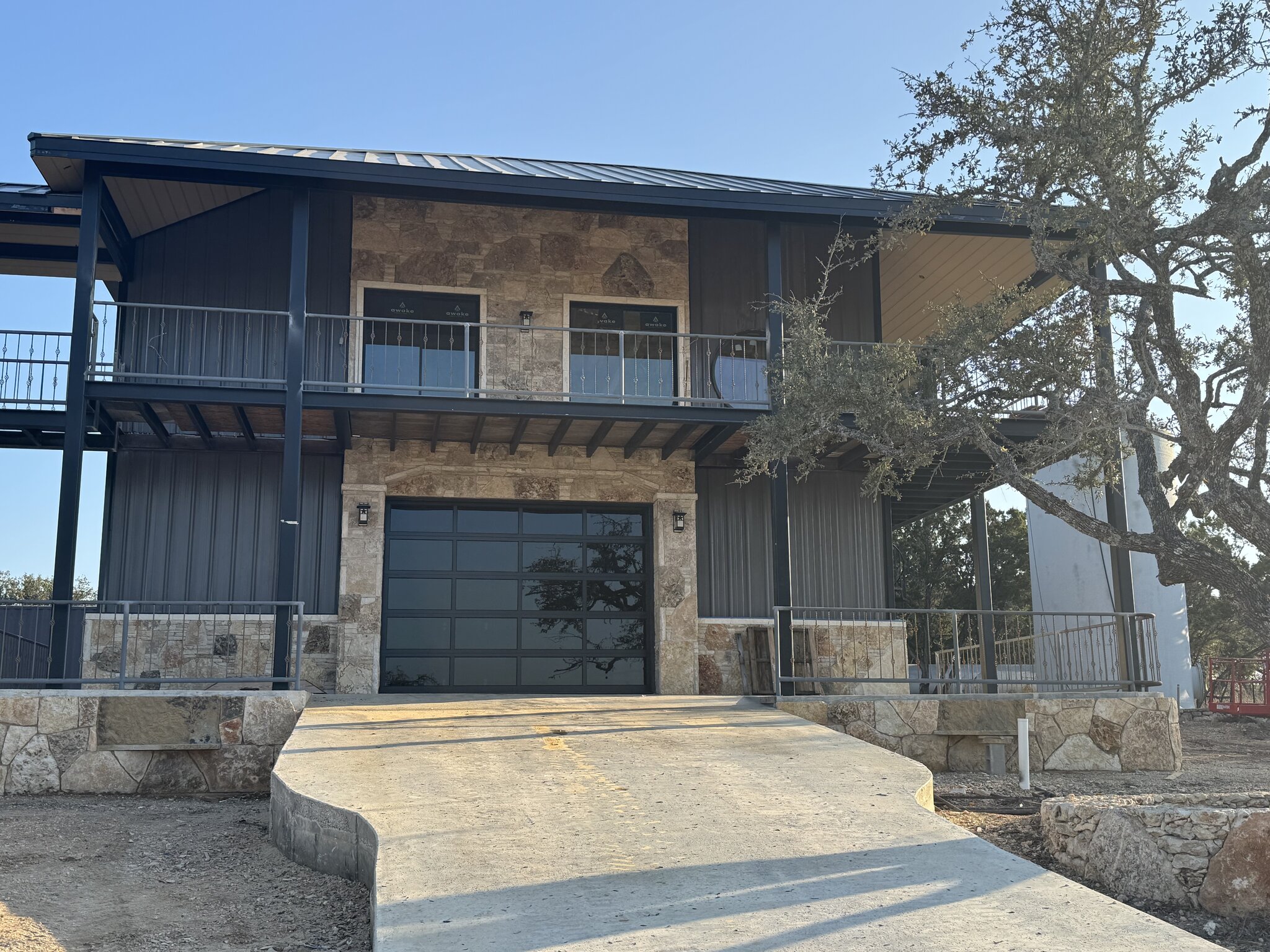
Building on solid limestone is structurally great news. Bedrock makes an excellent base for a foundation, so the rock itself is not the problem. The cost shows up in three places: cutting the rock instead of digging it, engineering the foundation to match the site, and getting a septic system and well to work over shallow stone.
So you hit rock. Is that good or bad for the build?
Solid limestone is mostly good. It gives you strong, stable bearing for a foundation, which is exactly what you want under a house. Hays County and most of the surrounding Hill Country sit on carbonate bedrock, with Edwards limestone over Glen Rose formations, according to the USGS and the UT Bureau of Economic Geology. That stone is why our views and creeks look the way they do.
The catch is simple. Rock has to be cut, not dug. A regular excavator scoops dirt fast, but when the bucket hits a continuous shelf of limestone, the job changes to hammering or breaking the rock loose. That takes more time, heavier equipment, and more labor. So the same hole that is cheap in soil gets expensive in stone.
What rock excavation actually costs
Rock excavation is the first place the limestone premium shows up. Breaking and removing rock with a hydraulic hammer or blasting commonly runs about $40 to $100 per cubic yard, according to HomeAdvisor, where ordinary soil digging costs a fraction of that. On a real lot, that difference adds up across three jobs.
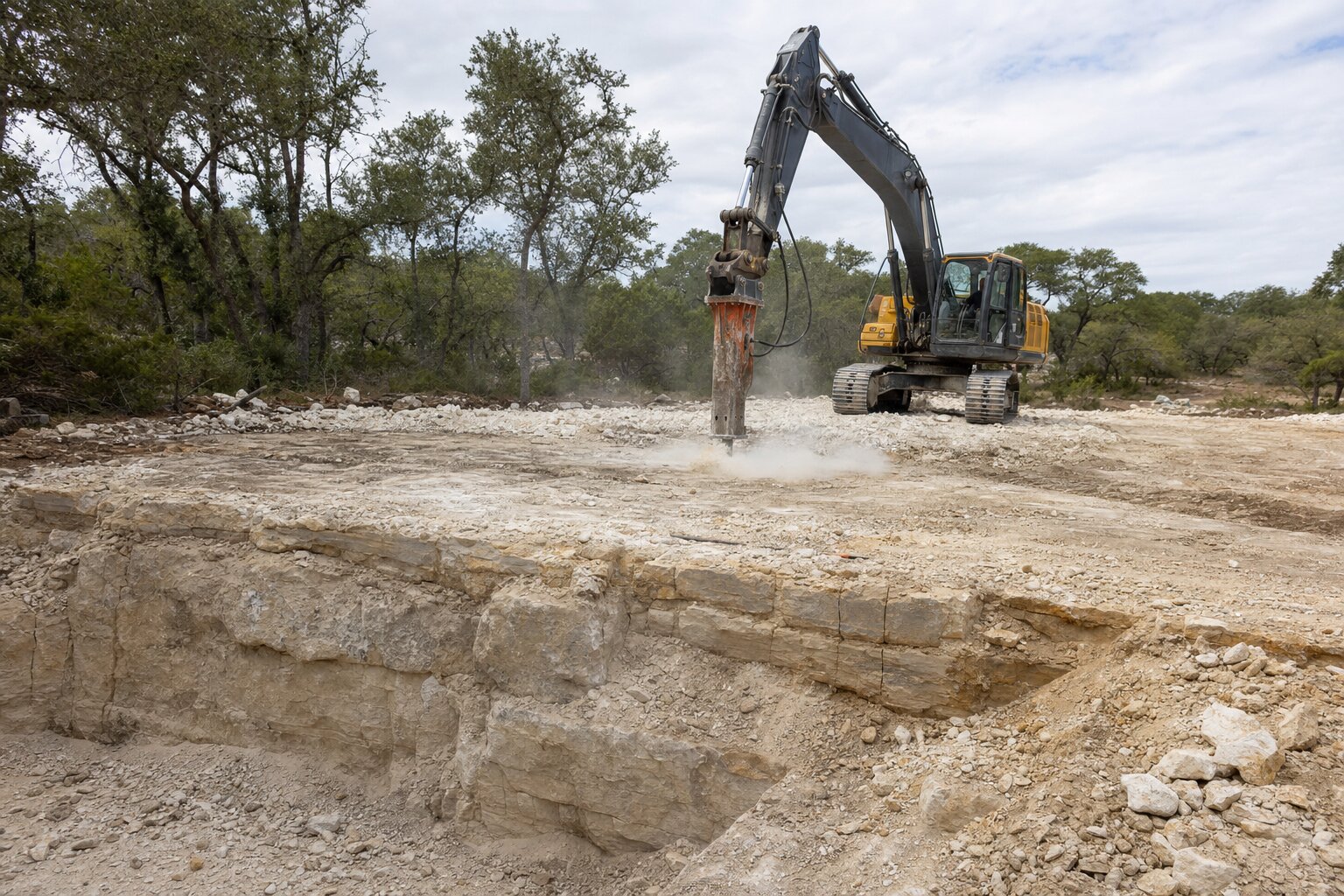
When we open Hill Country ground, we rarely find rock at the same depth twice. One lot has two feet of soil over a soft caliche you can rip with a standard machine. The lot next door has a hard limestone shelf eight inches down. That variation is why the same square foot of excavation can price very differently from one address to the next.
The premium hits more than the building pad. You are usually cutting rock in three places:
- The pad and footing trenches for the house itself, so the foundation sits level and true.
- Utility trenches for water, power, and drain lines that have to reach the house.
- The septic and well work, which we will get to, since both often go straight through stone.
Foundations on rock versus Hill Country clay
Here is the part homeowners rarely hear: solid limestone helps you dodge the most expensive foundation failure there is. Roughly 25% of US homes have some expansive-soil damage, and those soil losses cost more each year than earthquakes, floods, hurricanes, and tornadoes combined, according to Geology.com citing ASCE data. Solid rock does not swell and shrink, so it sidesteps that whole problem.
That does not mean you skip the engineering. Bedrock bears well, but the slab or pier design still has to match the actual ground, including any pockets of clay, fractured zones, or slope. This is why Iron C Construction works with engineers to design the foundation to the soil report rather than reusing a generic slab. A house on clay needs one approach. A house on a limestone shelf needs another. On a sloped shelf, accurate layout matters just as much, which is why construction staking on a steep lot comes before any forms go in. Getting that right up front is cheaper than fixing a cracked slab later.
So the tradeoff is honest. You may pay more to cut and prep solid rock, but you are buying a base that will not heave on you. That is a feature, not a flaw, and it is one reason careful builders welcome a rocky lot when you build on your lot in the Hill Country.
The part people forget: septic and a well
On acreage, the septic system and the well are where shallow limestone quietly raises the budget. Where rock sits close to the surface, the Texas Commission on Environmental Quality treats fractured rock as a restrictive layer, which often rules out a conventional drainfield and calls for an aerobic or sand-filter system instead. You can read the system types on the TCEQ OSSF hub.
Those engineered septic systems cost more to install and require ongoing maintenance and a service contract. There simply is not enough soil depth over the rock to filter wastewater the simple way, so the county requires the more involved system. It is a real line item, not an upsell. For the order in which septic permits and well drilling happen, see how the well and septic timeline works on a new build.
The well is the other one. Drilling a water well through Hill Country limestone runs more per foot than drilling through soft ground, with indicative figures around $35 to $65 per foot from WellDrillingCosts.com. Treat that as a ballpark, since depth to good water varies a lot across the region. Both of these are easy to forget when you are picturing the house, and both belong in the budget from day one.
What this means for your budget
Start with a base, then add the rock premium on top. The 2024 national median for a custom home was about $166 per square foot, and roughly $138 per square foot across the West South Central region that includes Texas, according to the NAHB. Those numbers are a starting point for the house, before any site or rock work.
The limestone premium sits on top of that base, and it is genuinely lot-specific. Rock depth, slope, drainage, access, and how far utilities have to run all move the number. There is no honest flat “limestone adds X dollars” figure, because the lot that needs eight feet of trenching cut through stone is a different job than the one with soft caliche to grade. That is exactly why a real site evaluation beats a guess from a spreadsheet.
How Iron C Construction prices a rocky lot
We price a rocky lot by looking at it first, not by averaging someone else’s project. Iron C Construction was founded in 2020 in Wimberley by Robert Castro, and we build across Hays, Travis, Comal, and Blanco counties, so we have cut plenty of pads into pale limestone and set foundations and septic on Hill Country acreage. We know how much the ground varies, which is why we start with the dirt.
A site evaluation looks at the things that actually drive cost:
- Rock depth and type, so we know whether we are ripping caliche or hammering hard shelf.
- Slope and drainage, which shape the foundation design and grading.
- Access and utilities, including how far water, power, and a drainfield have to reach.
From there we coordinate the foundation design with an engineer to match the soil, then build a transparent budget you can actually plan around. For reference, our construction staking is GPS and robotic layout to place the structure accurately on the lot. It is construction layout, not licensed land surveying. Honest scope, honest numbers, no surprises after the dirt opens up.
Talk to us before you buy or break ground
If you are weighing a rocky lot, the smartest money you can spend is on a look before you commit. We would rather tell you what the stone, the slope, and the septic really mean now than have you find out after closing. See how we approach building on your lot, then reach out to Iron C Construction for a consultation and a real site evaluation. We will walk the ground with you and give you a straight answer.