
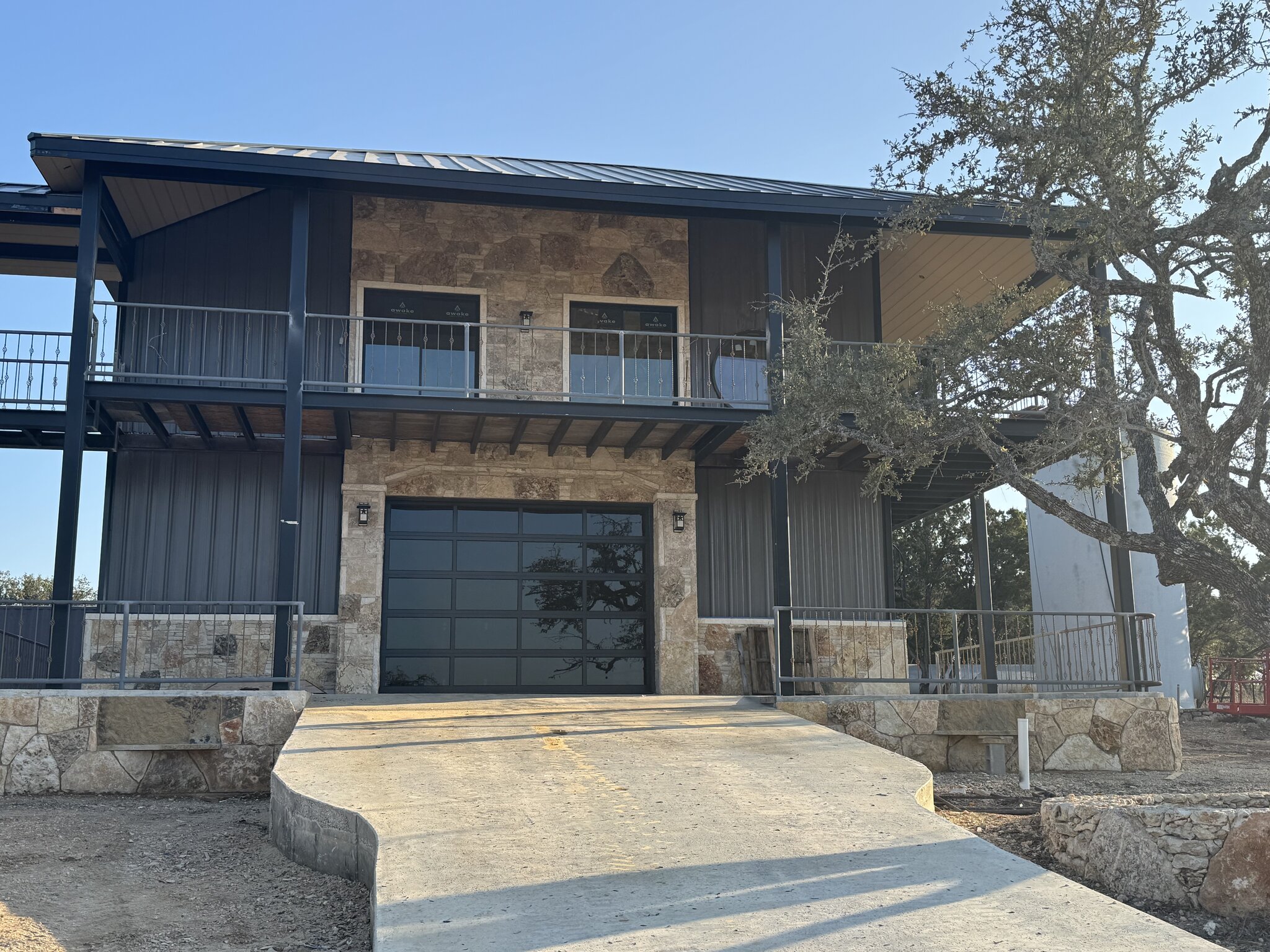
If you own acreage in Hays County, the honest answer is this: a barndominium usually wins on shell cost, build speed, and fire durability, while a traditional custom home wins on appraisal, financing, and resale comps. Both still need the same county permits and septic system. The right call depends on your lot, your loan, and how long you plan to stay.
Barndominium vs custom home: what actually separates them?
The biggest gap is the structure. The median custom or contractor-built home cost $166 per square foot to build in 2024 (NAHB Eye on Housing, 2025). A barndominium uses a metal or post-frame shell instead of a stick-framed one, and that single choice ripples through your whole budget and timeline.
A traditional custom home is wood-framed, built piece by piece on a slab or pier foundation. A barndominium starts as an engineered metal or post-frame building, then gets finished inside like any other house. Once the interior is done, most people can’t tell the difference from the curb. The structural skeleton underneath is where the two part ways. For the frame decision on its own, see how steel and stick framing compare on cost and speed.
Which is cheaper per square foot on Hill Country acreage?
On the shell alone, the barndominium typically costs less, though there’s no reliable published figure to cite for that. In our experience at Iron C Construction, a metal or post-frame shell goes up for less than a comparable stick-framed structure, mostly because the framing is faster and uses fewer labor hours. Measure that against the NAHB custom baseline of $166 per square foot.
Here’s the catch most people miss. Construction made up 64.4% of a new single-family home’s sales price in 2024 (NAHB, 2025), and the shell is only one slice of that. Your interior finishes, cabinets, flooring, plumbing, and HVAC cost the same whether they sit inside a metal frame or a wood one. So a barndominium saves you money on the bones, not on the parts you actually live with every day.
That’s the part we walk every client through. If you want quartz counters, real wood floors, and a chef’s kitchen, the savings shrink fast. The frame discount is real, but it doesn’t follow you into the finish-out.
One more cost note for acreage: the land work is a wash. Clearing, the pad, the driveway, the well, and the septic system cost the same whether you frame in steel or wood, and on a rural Hill Country lot those site costs are a big part of the budget. So when you compare a barndominium quote to a custom home quote, make sure both include the same site and utility scope. It is easy to think a barndominium is far cheaper when the lower number simply left the well, septic, or driveway out.
Does a barndominium really go up faster?
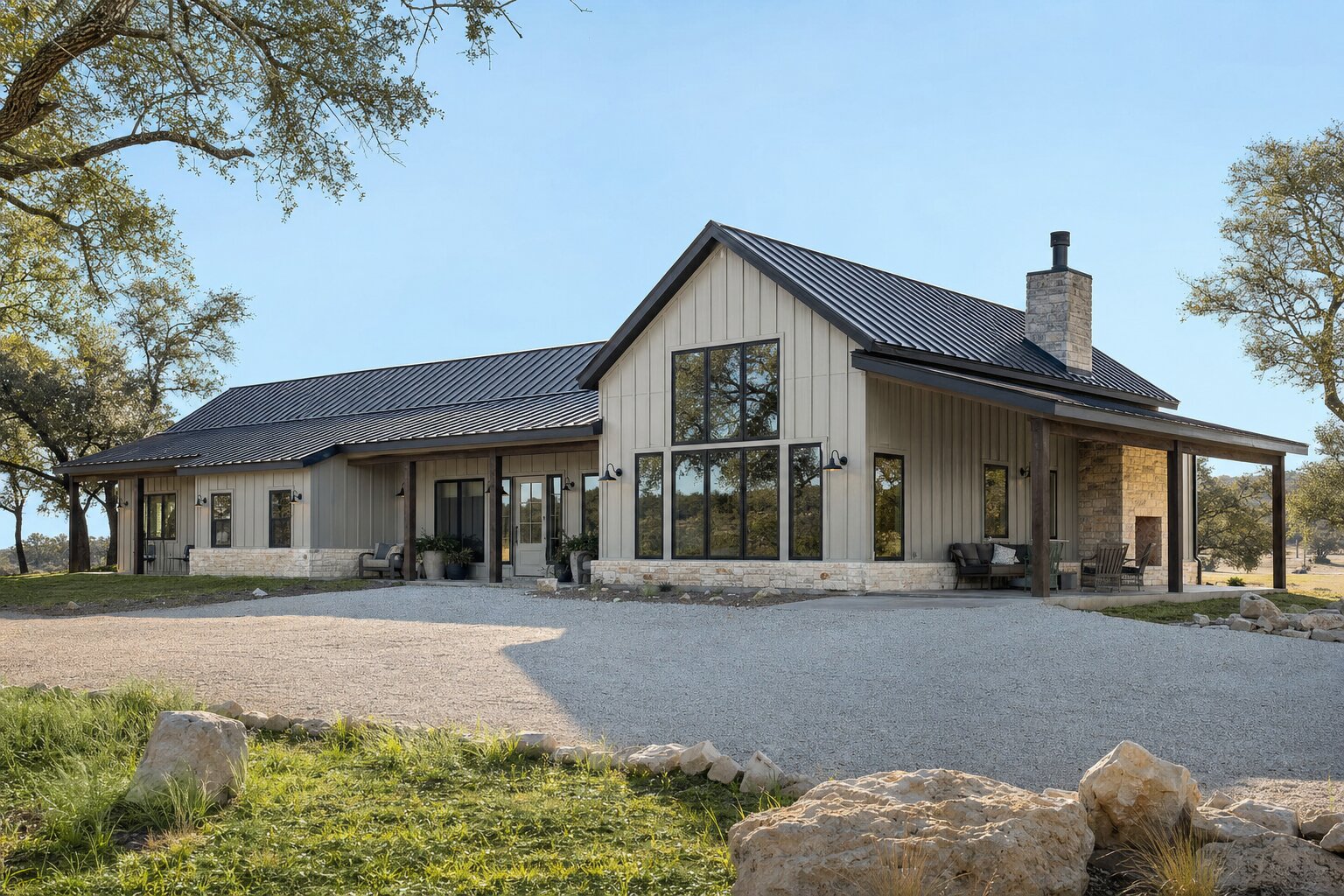
Usually, yes. We don’t have a citable industry number for build speed, so treat this as Iron C Construction’s own field experience rather than a statistic. A metal or post-frame shell can be dried in faster than a stick-framed house because the structure arrives engineered and the framing stage is shorter. On a sloped Hill Country lot, that faster dry-in matters when weather is unpredictable.
But speed on the shell doesn’t mean speed on the whole project. The interior buildout, the septic system, and the inspections run on the same clock for both house types. A barndominium gets you under roof sooner. It does not skip the slow, detailed work of finishing a home you’ll live in for decades.
How do the two compare on durability and insulation?
Steel framing brings a real durability edge. Steel is classified non-combustible, meaning it can’t burn (it melts near 2,700 degrees, far above a typical house fire of 1,000 to 1,800 degrees), per the Steel Framing Industry Association. Steel also won’t rot, warp, or feed termites, which is no small thing on Texas acreage.
Insulation is where you have to be careful. Metal framing has a problem called thermal bridging: heat flows straight through the metal studs, so a wall’s effective R-value ends up lower than its rated R-value. How and where the insulation is installed makes the difference, according to the U.S. Department of Energy. A barndominium can be just as comfortable as a custom home in a Texas summer, but only if it’s insulated the right way. Done wrong, those metal studs become heat highways, and your cooling bills tell the story. We spec the insulation approach early so the metal frame doesn’t cost you at the meter.
Upkeep is part of durability too. A standing-seam metal roof and metal siding shrug off Hill Country hail and sun better than many conventional finishes, and they don’t rot or invite termites. The tradeoff is that dents and fastener checks become their own maintenance items, and a metal building still needs good flashing and sealing to stay watertight. Built right, a barndominium is low-maintenance for decades. Built cheap, it leaks at the seams. The detailing is what separates the two.
Will a barndominium be harder to finance and appraise?
This is the strongest argument for a traditional custom home, and it’s a financing one. Barndominiums are still uncommon, so appraisers struggle to find comparable sales. If there’s nothing to compare to, no value can be assigned, and the lender can deny the loan, according to Fairway Independent Mortgage (2025).
A traditional custom home has thousands of comps in the Greater Austin and Hill Country market. Appraisals are routine, financing is straightforward, and resale is easier because more buyers understand exactly what they’re getting. A well-built barndominium can hold value too, but you may need a lender who has done these before, and you should plan for a longer appraisal process. If you expect to sell within a few years, the easier comps on a custom home are worth weighing seriously.
What does Hays County require, either way?
Both house types face the same county rules, so permitting is not a deciding factor. Hays County has no zoning in unincorporated areas, but any new home still needs a development permit, must meet the International Residential Code, and gets three inspections, plus an OSSF (septic) permit where applicable, per Hays County.
That last point catches people off guard. A barndominium is not a shortcut around code or septic. On acreage you’re almost certainly on a septic system, and that OSSF permit, the soil evaluation, and the inspections apply no matter what your walls are framed with. The county cares that the home is safe and code-compliant, not whether the studs are wood or steel. Plan for the same permitting timeline either way.
So which one fits your land?
Choose a barndominium if you want a durable, lower-shell-cost build that gets under roof faster, you’re staying long term, and you’ve lined up a lender comfortable with the appraisal. Choose a custom home if easy financing, a smooth appraisal, and strong resale comps matter more to you than shaving cost off the frame.
There’s no universal winner here, only the build that fits your lot, your loan, and your timeline. Iron C Construction has built both across Hays, Travis, Comal, and Blanco counties since 2020, and we’ll tell you straight which one makes sense for your acreage instead of steering you toward whichever is easier for us. If you’re weighing a barndominium against a traditional custom home, reach out and we’ll walk your land, your numbers, and your goals before you commit a dollar.