
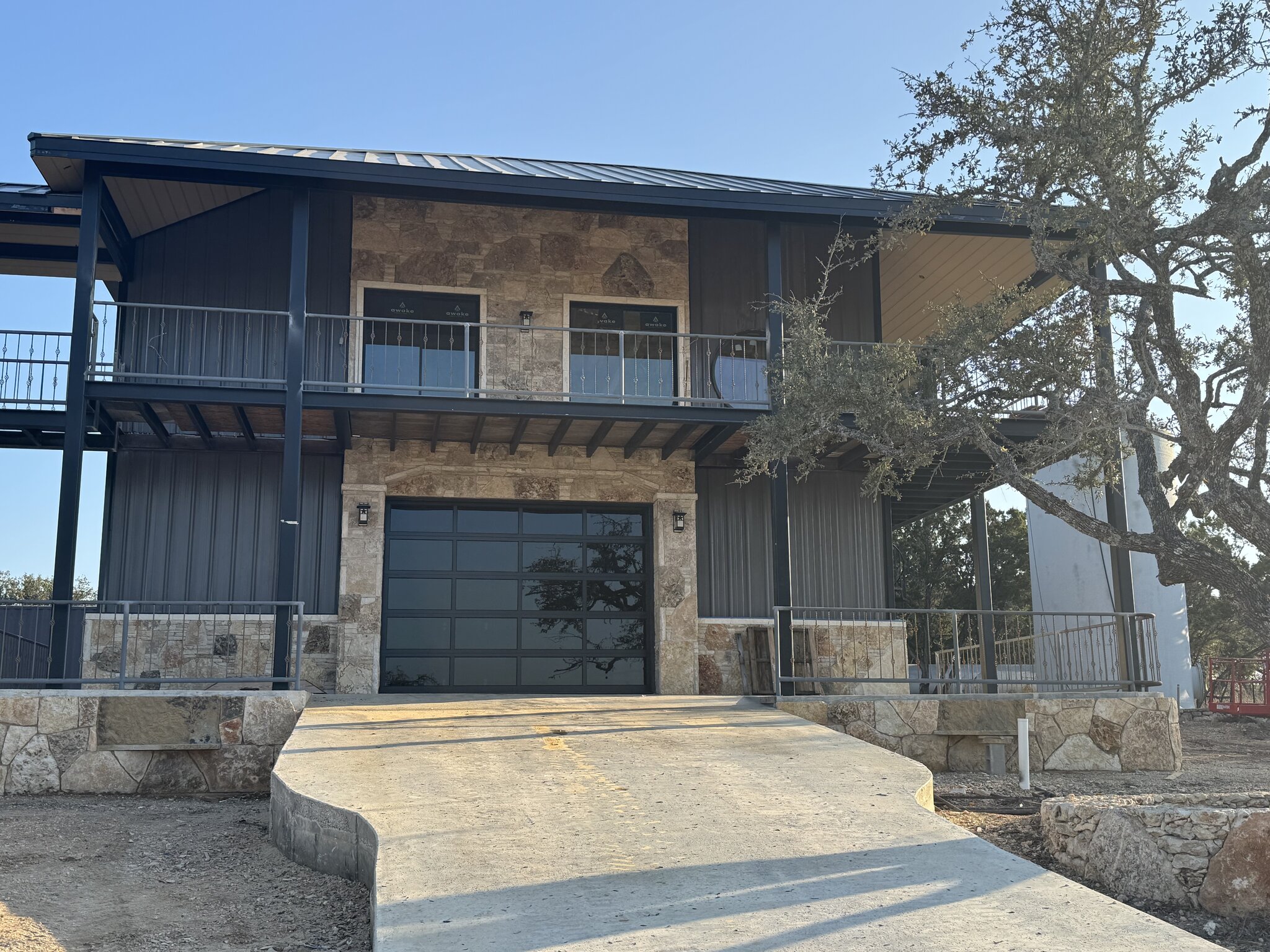
For most shops, warehouses, and commercial buildings, a pre-engineered metal building goes up faster and spans wider than conventional wood or masonry construction, and it won’t burn, rot, or feed termites. Conventional construction still wins on insulation simplicity, finish flexibility, and lender familiarity. The right pick depends on your span, your budget, and what the building has to do. If the building is a home, the same trade-offs show up in the barndominium versus custom home decision.
Which one actually costs less to build?
Here’s the honest answer: it depends on the building, and the per-square-foot numbers you see online are vendor estimates, not government data. The U.S. Census Bureau tracks total construction spending, not steel-versus-wood cost per square foot (U.S. Census Bureau), so nobody can hand you a clean national figure. What we can give you is our own project experience across the Hill Country.
On the large, simple, open-floor buildings we put up, steel usually comes in lower per square foot than conventional framing, and the bigger the box, the wider that gap tends to get. The savings come from a kit that ships ready to assemble and a frame that needs fewer interior supports. On smaller buildings, or anything with lots of rooms, finishes, and trim, that advantage shrinks. Once you’re chopping a steel shell into offices and bathrooms, the cost lines start to cross.
Does a metal building really go up faster?
In our experience, yes, and it’s usually the clearest reason a client chooses steel. A pre-engineered metal building arrives as an engineered kit: columns, rafters, purlins, and panels cut and punched to spec. There’s no waiting on stick framing crews to cut and fit lumber piece by piece, so the shell closes in sooner and you’re dried-in faster.
That speed matters more than people think. Every extra week on site is another week of labor, equipment rental, financing interest, and weather risk. Conventional construction is more forgiving when a design changes mid-build, since a carpenter can adjust framing on the fly. A steel kit is locked in once it’s engineered, so you trade some flexibility for a shorter, more predictable schedule. For a warehouse or shop, that trade is usually worth it.
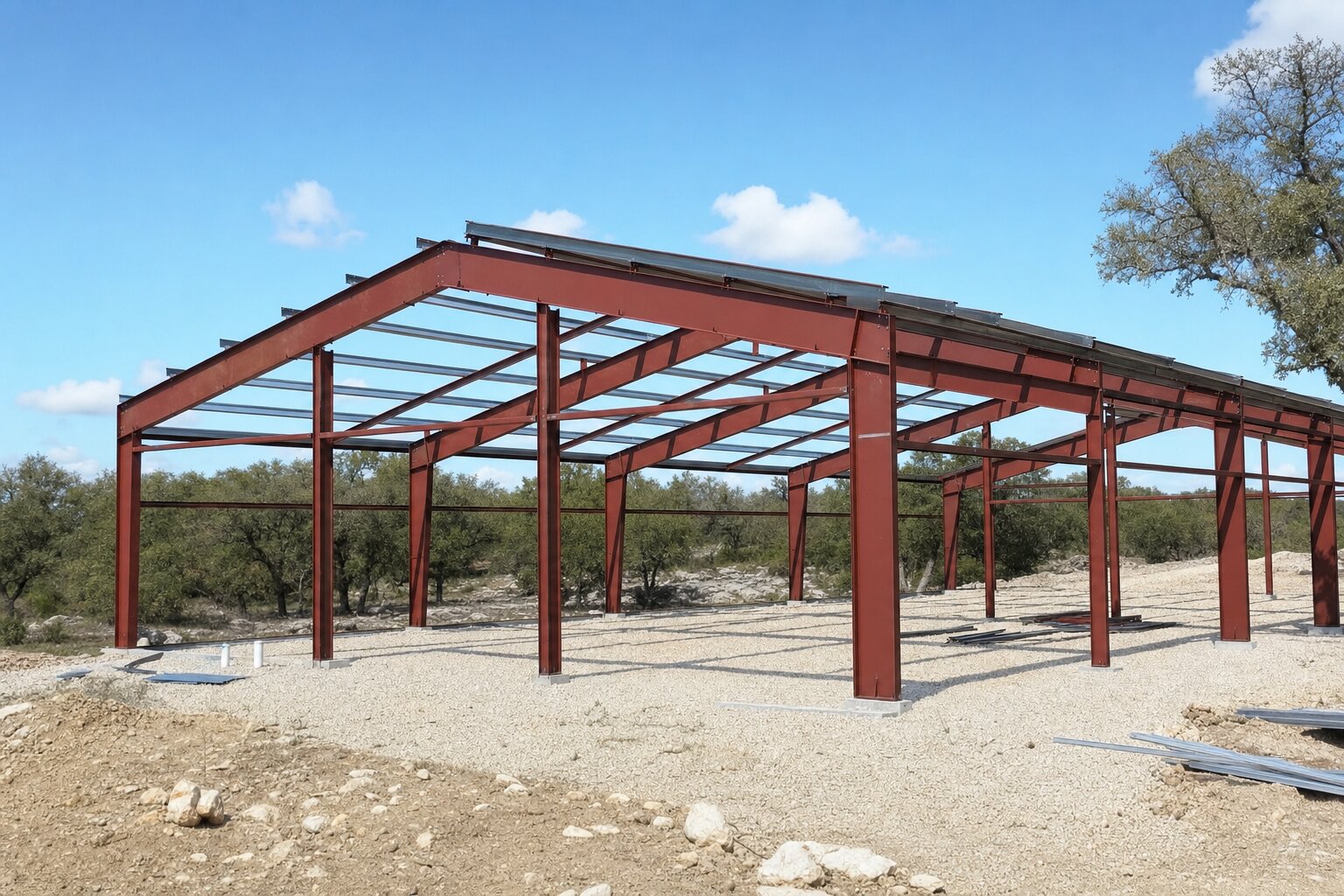
How does clear span change what you can build?
Steel’s high strength-to-weight ratio is the reason a metal building can carry a roof across a wide, column-free floor. Conventional framing needs interior bearing walls or posts to hold up long spans, which chop up the floor plan. From our own engineering work on Hill Country shops and warehouses, that open span is often the whole point.
Think about what goes inside. A clear-span shop lets a contractor swing a boom truck around without dodging posts. A warehouse can rack to the walls. An event barn or equipment building stays wide open. Conventional construction can do big rooms too, but you’ll usually pay for engineered beams and steel inside the wood frame to get there. If wide-open space is the goal, steel reaches it more directly. If you’re building lots of smaller, divided rooms, that span advantage matters less.
Which holds up better to fire, rot, and termites?
Steel framing is a noncombustible material. The U.S. Department of Energy lists it alongside concrete and masonry for fire-resistant wall assemblies (DOE Building America), so the frame itself won’t add fuel to a fire the way wood does. In Texas, where dry summers and wildfire risk are real, that’s worth weighing. For homes, the frame is only one piece. Building to survive wildfire in the Hill Country also depends on the roof, vents, and siding.
Steel is also inorganic, so it gives termites nothing to eat and won’t rot. Cold-formed steel is recognized in the International Residential Code as a method for termite-resistant construction (AISI / BuildSteel). Steel is dimensionally stable too, meaning it doesn’t warp, shrink, or twist the way lumber can as it dries. For wind, FEMA’s safe-room standard shows what heavy-gauge steel can do: a P-361 safe room is built to withstand winds up to 250 mph, the upper end of an EF5 tornado (FEMA P-361). Conventional construction, framed and detailed well, holds up fine for most uses, but steel sets a higher ceiling on durability.
Where does conventional construction win? Insulation and finish.
This is where steel gives something back, so we won’t pretend otherwise. Steel studs conduct heat, which creates thermal bridging. Under ASHRAE 90.1, R-11 cavity insulation in a steel-framed wall at 16-inch spacing performs at only about R-5.5 effective, roughly half its rated value, because the studs short-circuit the insulation (Oak Ridge National Laboratory).
You can solve it. Continuous exterior insulation, thermal breaks, and good design close most of that gap, and we build steel walls that hit code and stay comfortable through a Central Texas summer. But it’s an extra step. Wood framing insulates more simply because the framing itself resists heat better. Conventional construction also bends easier to custom finishes, trim, rooflines, and the warm look a lot of homeowners want. For a polished custom home, that finish flexibility is a real edge.
Which is the greener choice over the building’s life?
Steel has a strong recycling story. Construction steel is recycled at a rate of about 74 percent, and steel is 100 percent recyclable at the end of its life with no loss of quality (AISI / Steel Recycling Institute). U.S. furnaces consume around 70 million tons of domestic steel scrap a year (American Iron and Steel Institute), so the frame you put up is largely recycled and stays recyclable.
Wood is renewable and stores carbon, which is its own sustainability case, so this isn’t one-sided. But a steel frame that lasts decades, resists fire and pests, and gets fully recycled at the end carries a durable environmental argument. For a building meant to stand for fifty years, longevity is part of the green math, not just the materials list.
What about maintenance, permits, and your lender?
A metal building generally asks for less upkeep over time. There’s no wood to rot, no studs feeding termites, and quality panels shed weather for years before they need attention. Conventional construction needs more routine care: paint, trim, pest treatment, and the slow effects of moisture on wood. Neither one is maintenance-free, but steel tends to be lower over a long ownership.
Two practical notes before you decide. First, both building types need the same permits here. A steel shop and a stick-framed shop both go through Hays County review, and counties like Travis, Comal, and Blanco have their own steps. Second, lenders and appraisers are simply more familiar with conventional construction, especially for homes. That familiarity can make financing and resale smoother. A steel building is an easier sell as a commercial shop than as a custom residence, and that’s worth knowing up front.
So which should you build?
Pick steel when you want a large, open, durable building up fast, like a shop, warehouse, or commercial space where clear span and speed pay off. Lean conventional when finish, insulation simplicity, or lender comfort matter most, which is often the case for custom homes. Plenty of projects land in the middle and use both.
Iron C Construction has built both since 2020, residential and commercial, across Greater Austin and the Central Texas Hill Country, so we don’t have a horse in this race. We’ll look at your span, your budget, and how you’ll use the building, then tell you straight which approach fits. If you’re weighing metal buildings for a shop, warehouse, or commercial project, reach out and we’ll walk the tradeoffs with you before you commit a dollar.