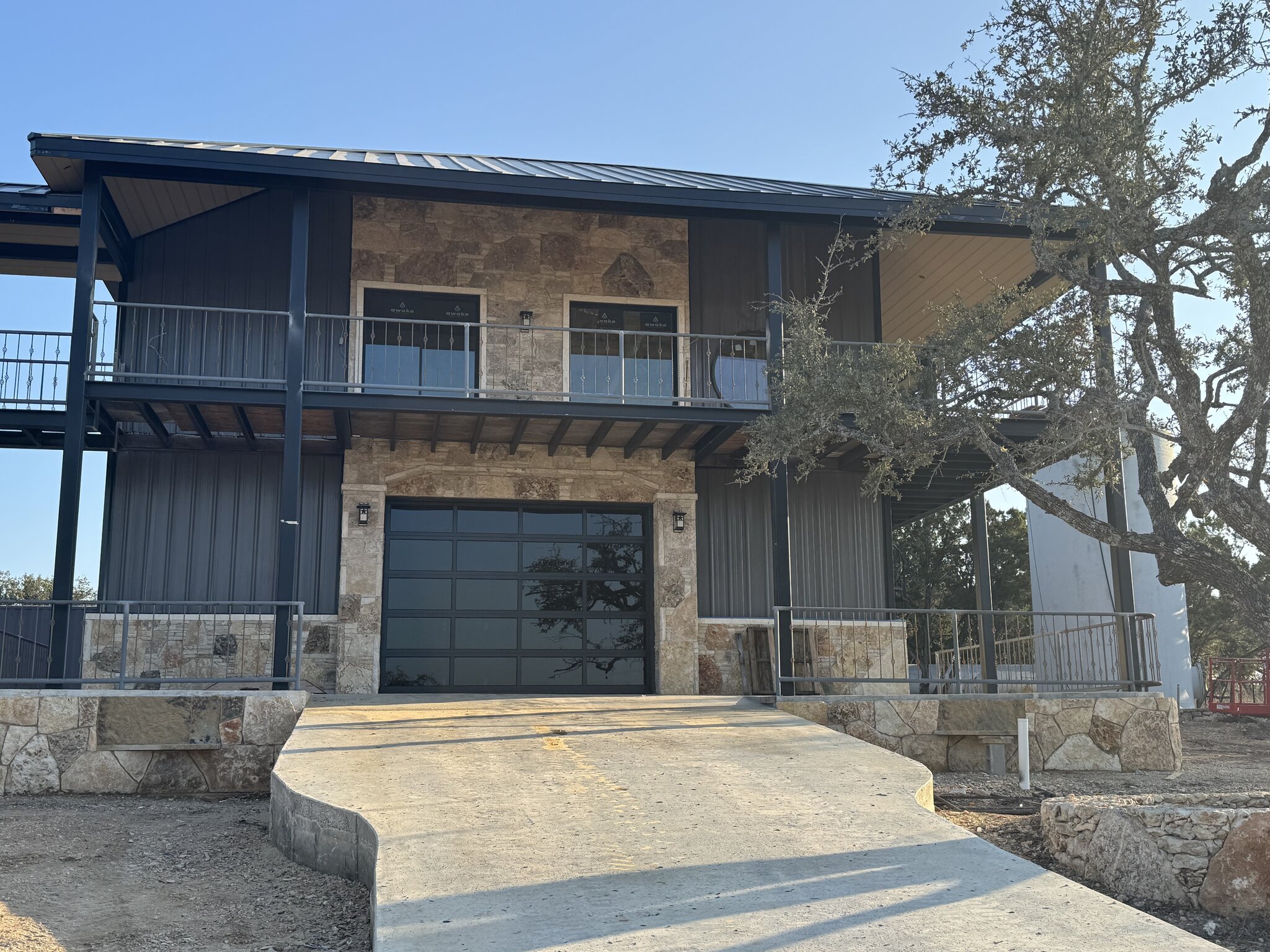
Outside Kyle’s city limits, the City of Kyle’s building permit stops applying, and Hays County becomes the main permitting office for a new home. Kyle’s building department requires permits for construction on property within the city limits. In the ETJ, the extraterritorial jurisdiction around the city, Section 212.003 of the Texas Local Government Code generally bars a city from regulating the use, size, height, or number of buildings on a tract.
That does not mean there are no rules. In Kyle’s ETJ, you will still need a Hays County development permit, a septic permit where there is no sewer, and three third-party inspections on a new house. Some city rules also reach past the limits, including subdivision review, water quality, and signs. And since 2023, Texas law has let landowners petition to leave the ETJ altogether.
City limits, ETJ, or unincorporated Hays County
Land around Kyle falls into one of three buckets. Inside the city limits, Kyle’s building permits, codes, and zoning apply. Just outside is the ETJ, which the Texas Local Government Code defines as the unincorporated land next to a city’s boundaries, out to a distance set by population. Past the ETJ of any city is the rest of unincorporated Hays County, where the county is the main regulator.
The ETJ distance scales with the city’s size, under Section 42.021 of the Local Government Code.
| City population | ETJ extends from the city limits |
|---|---|
| Under 5,000 | Half a mile |
| 5,000 to 24,999 | One mile |
| 25,000 to 49,999 | Two miles |
| 50,000 to 99,999 | Three and a half miles |
| 100,000 or more | Five miles |
The City of Kyle’s Address Lookup and Jurisdiction Finder shows a property’s jurisdiction, annexation date, subdivision, and utility provider. Start there before you buy, design, or price anything.
What can the City of Kyle regulate in its ETJ?
Less than most people expect. Section 212.003 of the Local Government Code lets a city extend its subdivision rules into the ETJ. But unless another state law allows it, the city has no authority over how a building or property is used. It also may not regulate the bulk, height, number, or size of buildings on a tract, or the number of homes per acre. In practice, there is no city zoning in the ETJ.
On building codes, Kyle’s own pages draw the same line. The city requires a building permit before construction on property within the city limits, where it has adopted the 2021 International Building and Residential Codes. Signs are different: the city says signs in the city limits or the ETJ need a sign permit.
Subdividing is where the city still matters most. State law requires a city and county to agree in writing on which of them reviews plats in the ETJ, and a plat there cannot be recorded without that approval. Hays County’s fee schedule lists an interlocal fee for plats in Kyle’s ETJ. The county’s development regulations also note that the City of Kyle Water Quality Ordinance is in effect in Kyle’s ETJ. If you plan to split land or build more than one home, confirm with both the city and the county which one reviews your tract.
Hays County permits for a new home outside Kyle
For a single home on its own tract, Hays County is the office you will see most. The county says every kind of development in the unincorporated area needs a permit, from houses and outbuildings to grading and creek crossings. For a new home, the county asks for a compliant parcel, a development permit, and a septic design. Its January 2026 fee schedule lists a $100 development permit outside the mapped floodplain, $300 for a home inside it, and $610 for a single-family septic permit application.
Hays County also requires the Notice of New Residential Construction. Under state law, a new house in the unincorporated area of a county that has opted in, as Hays County did in 2009, has to conform to the International Residential Code. It needs at least three inspections: at the foundation before concrete, at framing and mechanical before drywall, and at completion. The county does not do those inspections itself, so the builder hires a third-party inspector.
Two timing details matter. A Hays County development permit is good for one year to start construction and two years from issuance to finish. And FEMA’s 2025 preliminary flood maps cover Kyle and unincorporated Hays County, so check both the current and preliminary maps if the land is near a creek. As a construction company in Kyle, we build that permit and inspection schedule into the timeline before the first draw.
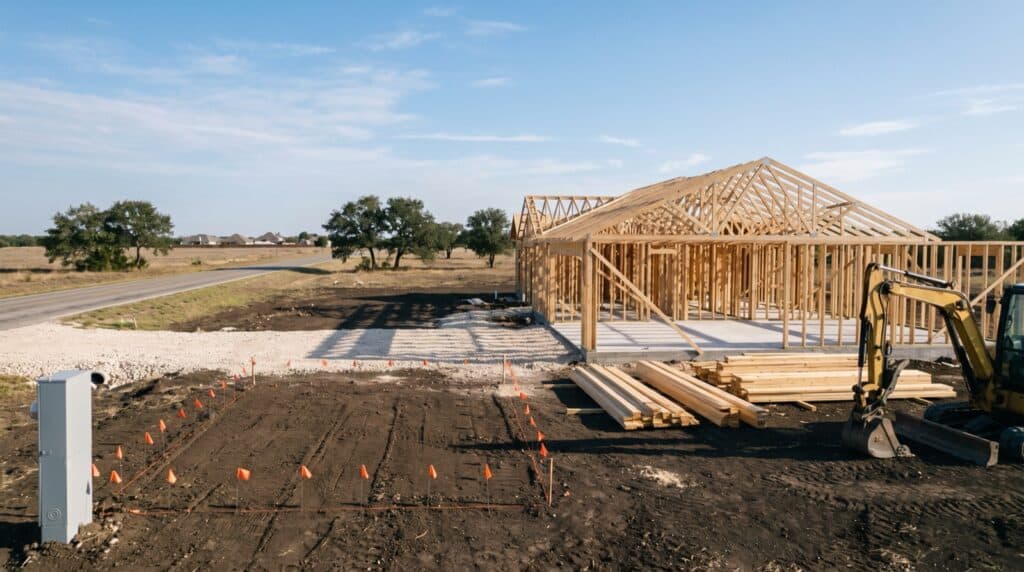
Water, septic, and other utilities beyond the city line
The City of Kyle says not every resident is served by the city’s water system. Its utility page lists four water providers in the area: the City of Kyle Public Water System, County Line Special Utility District, Texas Water Utilities, and Goforth Special Utility District. The Jurisdiction Finder will tell you which one serves an address, and that provider’s service terms are what you will budget for.
Wastewater is the bigger question. If the tract is not on a city or utility sewer line, the house needs an on-site septic system. In unincorporated Hays County, a septic permit is required for every system regardless of lot size or acreage. The application needs a site plan and design, a location map, a floor plan, and a tax account summary. Aerobic systems also need a two-year initial maintenance contract.
One rule ties septic back to the land itself. Hays County will not issue a septic permit for a tract found to be in violation of its subdivision regulations. A lot that was split off without proper approval can stall the whole project. Our guide to well and septic timelines on a new build covers the site evaluation and review clock in more detail.
Can you get your land out of Kyle’s ETJ?
Often, yes. Senate Bill 2038 took effect on September 1, 2023, and added a petition process to Chapter 42 of the Texas Local Government Code. A petition to release land must be signed by more than half of the registered voters in the area, or by the owners of a majority in value of the land. Signatures have to be collected within 180 days. The petition must include a map and a boundary description by metes and bounds, or by lot and block if a plat is recorded.
Once the signatures check out, the city has to release the area. If it does nothing by the later of the 45th day after it receives the petition or its next council meeting after the 30th day, the land is released by operation of law. Released land cannot be put back into the ETJ unless the owner asks.
In Kyle, petitions go to the City Secretary’s Office at 1700 Kohlers Crossing. The City of Kyle ETJ release page says petitions need original wet signatures, must be notarized, and carry a fee set by the city’s fee schedule.
What the Supreme Court and the 2025 Legislature changed
Cities pushed back on the law. In Elliott v. City of College Station, decided May 9, 2025, the Texas Supreme Court noted that College Station had joined more than a score of other cities challenging SB 2038 in separate litigation. The court said the statute “is presumed constitutional and remains the law.” It also put the point plainly: “Release is a matter of paperwork, not permission.”
The Legislature then amended the process through House Bill 2512, effective September 1, 2025. It confirmed that releases under the petition and election processes do not need city consent. The election route already needed a petition from at least 5 percent of an area’s registered voters. HB 2512 added that the filer must live in the area and gave the city seven business days to notify residents and landowners. A landowner can also opt out of an election release.
You may have read that lots under 12 acres can no longer petition out. That limit, and a similar one for single lots in large subdivisions, is written for a narrow case. It applies only to a city in four or more counties, one of which has 2.1 million or more people and borders a county of 2.6 million or more. Kyle is not that city. One older exception can reach Hays County, though. The law excludes land that was voluntarily added to an ETJ in a county that grew more than 50 percent from 2010 to 2020 and has more than 240,000 people. Community Impact, citing Census data, reported Hays County grew 53 percent to 241,067 residents over that decade. If your land joined Kyle’s ETJ at an owner’s request, ask the city whether it qualifies.
Should you leave the ETJ before you build?
That depends on the tract and your plans, and it is a call to make with your own attorney, not your builder. Leaving the ETJ does not take you out of Hays County, so the development permit, septic permit, and three inspections still apply. What changes is the city’s reach over subdivision review and the other city rules that apply in the ETJ. Released land also cannot be brought back into the ETJ or the city limits unless the owner asks.
For a single home on an existing legal lot, the city’s role in the ETJ is already narrow. For land you plan to divide, the choice matters more. Sort it out before you close on the property, as we cover in our guide to buying Hill Country land to build on.
How Iron C Construction approaches a build in Kyle’s ETJ
Iron C Construction was founded in 2020 by Robert Castro in nearby Wimberley, and our Construction Coordinator, Arthur Leyva, brings more than 20 years in construction. For a home or shop outside Kyle’s city limits, we work through the same checklist every time:
- Run the address through Kyle’s Jurisdiction Finder to confirm city limits, ETJ, or county, plus the utility provider.
- Confirm the parcel is legal and whether a plat or replat is needed, and who reviews it.
- Price water and wastewater early, including the provider’s tap and line costs or a septic design.
- Line up Hays County permits and the third-party inspector so each inspection is booked ahead of the stage it covers.
We are builders, not attorneys, so for an ETJ release we point you to the city and your own counsel. If you have land outside the city limits and want a straight read on building there, tell us about your project in Kyle and we will walk the tract with you.